Zyra wasn't built in a boardroom
It was built at the counter, after closing time, by watching how real shops actually run. Here's where it started, and what keeps it going.
A notebook, then a platform
It started with a question nobody had time to answer.
Hassan grew up around small shops, and he kept noticing the same thing. The owner locks up, sweeps the floor, then sits at the counter for another hour or two adding up the day by hand. Some nights it balances. Some nights it doesn't, and there's no easy way to tell why.
It was the same story in different shops and different cities. A spreadsheet that got too big to open. A point-of-sale that worked great until the day it didn't. A WhatsApp group for orders that nobody could keep up with. Everyone had their own patchwork, and none of it quite held together.
It wasn't the kind of problem most tech people talk about. The owners weren't asking for AI or dashboards. They just wanted to go home a little earlier, sure that the numbers were right.
Syed Hassan Jawad
Founder & Chairman · Architect of Zyra
Hassan is a builder. He designed Zyra's architecture, wrote most of the early code himself, and still tests it on the same kind of cheap Android tablet a real cashier would use. If it's slow or fiddly on that, it isn't done.
He doesn't talk about Zyra in market-size terms. He talks about the salon owner who finally took a Sunday off, the restaurant that stopped losing money to wrong orders, and the pharmacist whose books balanced for the first time in months. That's the part he actually cares about.
The moment it stopped being an idea.
There wasn't one moment, really. There were a dozen, stacked up until they were too much to ignore.
One was in a dental clinic, watching the receptionist juggle four browser tabs to bill a single patient. Insurance in one, the appointment in another, consumables stock in a third, and an old accounting program in the fourth. She kept apologising the whole time, to the patient and to herself, for how long it took.
That night, Hassan wrote one line in his notebook: what if all of those were the same screen?
That question is what Zyra has been answering ever since. Not how to add more, but how to make it all add up to one.
It turned into a discipline. The platform had to grow in every direction, from restaurants and hotels to factories, couriers, tailors and opticians, without ever making the work harder for the person at the counter. If it didn't make their day simpler, it didn't ship.
Four things we don't compromise on.
Trends change and features come and go. These stay.
Good software gets out of the way
If a cashier has to stop and think about the app, the app failed. The best tools are the ones you stop noticing, the ones that make the person using them look sharper, not slower.
The numbers have to be honest
What the screen shows at closing time has to match what's in the drawer. No clever caveat survives a missing note. Every figure on every report is built to hold up to an owner, an accountant, and a tired cashier all at once.
We're really selling peace of mind
Owners don't buy features. They buy the evening they got back, the sleep they got because the books closed clean, and the confidence to open a second branch because they can finally see the first one.
Built for the worst night, not the demo
Most software is built to look good in a demo. Zyra is built for 11pm on a Saturday, when the internet drops, the printer jams, and the queue keeps growing. If it doesn't hold up then, it doesn't ship.
From a notebook to a platform.
Three years of small decisions, all in the same direction.
- Late 2022
The observation
It started with a notebook, not a product idea. Hassan kept a running list of the same problems he saw in shop after shop: stock in a spreadsheet, orders in a WhatsApp group, receipts in a drawer, and a POS that always seemed to break at the worst possible time.
- Early 2023
The first sketch
The first version of Zyra was three boxes on the back of a receipt: sell, count, know, with arrows between them. The goal wasn't to build something clever. It was to build something nobody would have to be taught how to use.
- 2023 – 2024
Listening first
For almost a year, Hassan didn't ship anything. He spent the time behind the counter at salons, pharmacies, restaurants and a small clinic, watching where people got stuck and what they reached for when something went wrong. Most of what Zyra does today came out of those hours.
- 2024
Building it properly
The first real version went live with three businesses that needed it working the next morning, not someday. Speed was the fixation: if a sale took too long on a cheap tablet, everything else stopped until it was fast again.
- 2025
From tool to platform
One point of sale turned into fifty-nine. Salon, restaurant, hotel, pharmacy, courier, vet, dental, optical, jewellery, factory floor. Each one shaped by an owner who didn't want a demo, just software that already understood their trade.
- What's next
Deeper, not louder
The next few years aren't about more noise. They're about software that does more of the thinking: the till that reorders on its own, the dashboard that shows you the one number worth your evening, the platform that stays out of the way.
What that notebook became.
Three boxes on a receipt (sell, count, know) grew into one platform you can run a whole shop on.
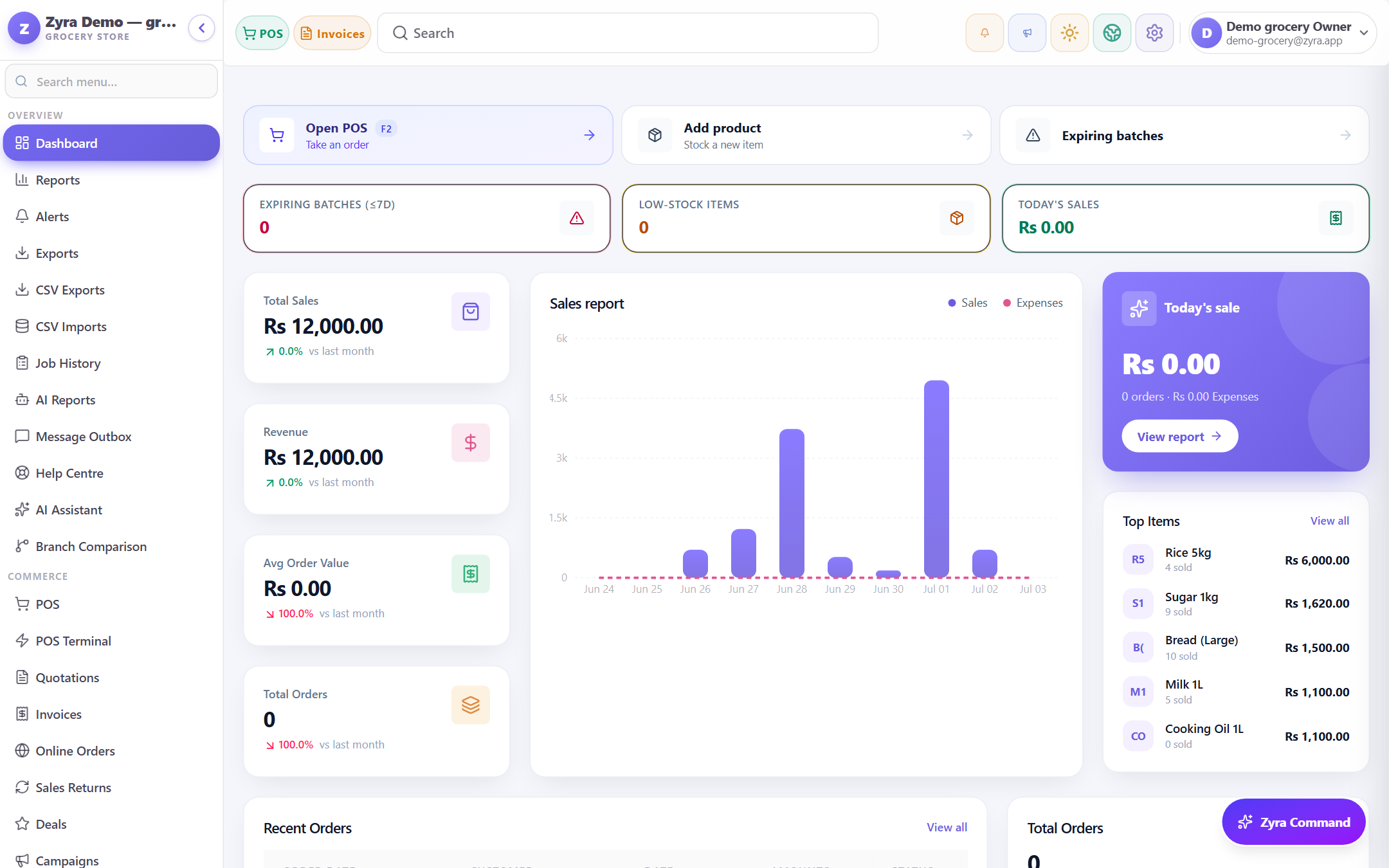
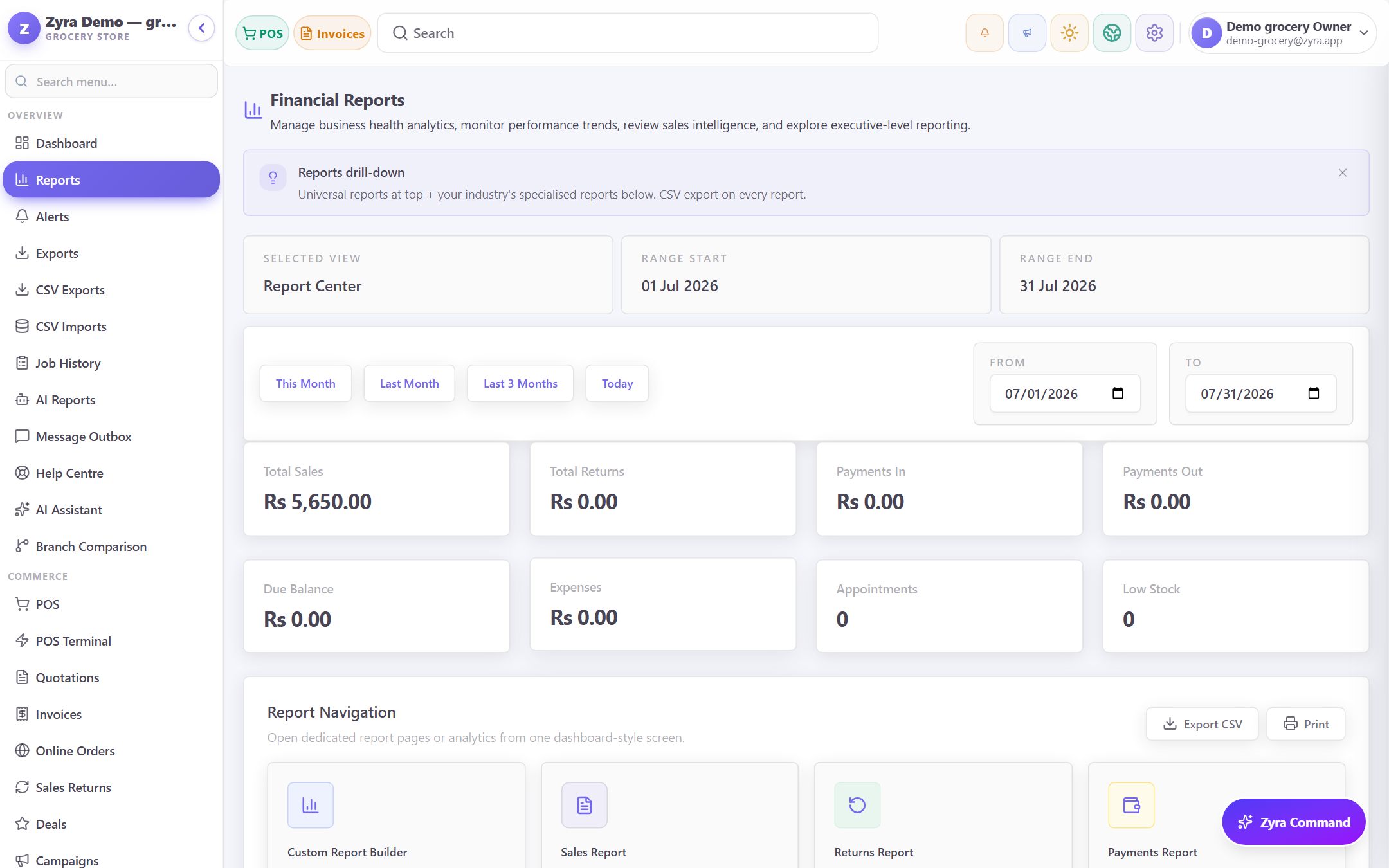
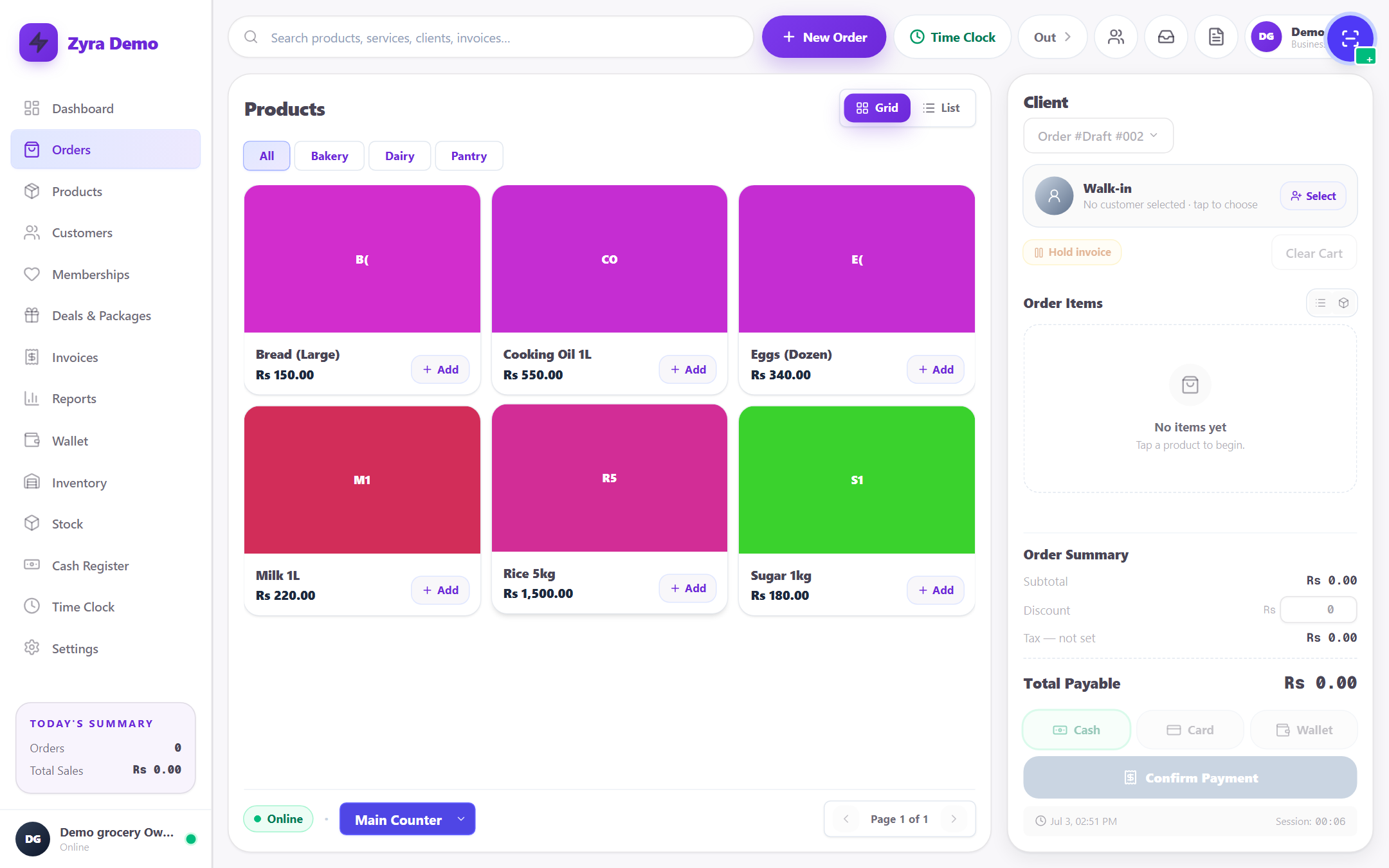
Three boxes on a receipt.
A whole business under one login.
None of this was on that first sketch. It came one owner at a time: a pharmacist who needed batch expiry, a restaurant that needed the kitchen to hear the order, an accountant who wouldn't trust a total she couldn't trace. Every answer stayed. This is what they add up to.
A till that already knows your trade
- One point-of-sale that reshapes itself for 59 trades — retail, restaurant, salon, pharmacy, clinic, and the rest.
- A live restaurant floor with tables, courses and a kitchen display that fires the moment you send.
- Split bills, multi-tender drawers, camera barcode scanning, gift cards and loyalty — built in, not bolted on.
The shop, open after you've locked the door
- A storefront that ships with the sale — themes, checkout, payments, abandoned-cart recovery.
- Area-based delivery that routes each order to the branch that serves it, with the right fee.
- Native iOS & Android apps and eleven languages, so the store fits the customer, not the other way round.
Books that are honest by the time you look
- Real double-entry accounting behind every sale — a trial balance that balances because it can't not.
- Tax done right for 43 countries, FBR and ZATCA e-invoicing included; recurring journals post themselves.
- Many branches, one clean set of numbers — consolidated the way an auditor would want to read them.
The team, without the paperwork evening
- Staff, roles and shifts; attendance that reconciles to payroll; statutory deductions handled.
- Spend limits and approvals so a discount or a refund needs the right person, not a phone call.
- Recruitment through to appraisal — the whole working life of a hire in one place.
A quieter kind of intelligence
- An assistant that answers on your own data — today's takings, slow movers, who owes what — in Roman Urdu or English.
- No API key, no per-message bill, nothing leaving your business. It runs where your data already lives.
- The dashboard flags the one number worth your evening, then gets out of the way.
All of it was there the night Zyra first opened for a real shop. A feature that isn't ready when you need it was never really a feature.
Give every owner their evening back.
We're here to take the busywork off the people running small and growing businesses, so the hours they used to spend reconciling and chasing turn into hours with their team, their family, or themselves. We don't measure success in code shipped. We measure it in lights turned off earlier.
A million businesses running calmer than they thought they could.
We want a world where a salon, a clinic, a workshop or a corner restaurant runs on the same quality of tools the big chains use. Where opening a second branch isn't a gamble. Where the books close themselves every night, and the software stays behind the work instead of in front of it.
Three lines worth keeping.
“I didn't want to make running a business look easy. I wanted to make it feel possible.”
Syed Hassan Jawad
On the night the first version went live
“The best thing a tool can do is get out of the way. A lot of Zyra's best work is in the buttons you never see.”
Syed Hassan Jawad
On the design philosophy
“Every shop I sat in had someone doing math late at night. That was the whole spec.”
Syed Hassan Jawad
On where Zyra began
This one's for you.
For the woman who opens the salon at nine, closes at ten, and still has the patience to teach her apprentice at the end of it.
For the pharmacist who knows half the neighbourhood by name and is still getting the hang of the new inventory app.
For the cook who became an owner and now spends more time in spreadsheets than at the pass.
For everyone who's ever stayed late because the books wouldn't close: we built Zyra so you wouldn't have to.
What's next: deeper, not louder.
The next few years are about depth, not noise. More trades, yes, but mostly more knowing. A platform that learns how your business runs and has the right answer ready before you ask. A till that reorders for you. A dashboard that shows you the one number that matters tonight.
We want the kind of intelligence that doesn't demand your attention, the opposite of a popup. Software you barely notice, because it just works.
And we're building it the way we started: carefully, with a notebook open and a cashier in mind.
Come see what we built for you.
Five minutes in the demo will tell you more than any founder's note.
— Hassan